Hi all,
I just want to share the videos that I upload just now... It is about steps on how to create a simple mind map using the tools name Text2Mindmap. In general, a mind map is a good tool for visual learners. The maps are also easier to understand, which saves time and increases productivity.
Let's Like & Subscribe to my youtube channel to get more videos.
https://www.youtube.com/watch?v=oiOalGzwHzo&feature=youtu.be
Monday, June 1, 2020


Wednesday, April 15, 2020
Theory of Multiple Intelligences
According to Howard Gardner (2006), every human being has at least two or more intelligence such as verbal-linguistic (VL), logic-mathematic (LM), intrapersonal (IA), interpersonal (IN), visual-spatial (VS), musical (MR), natural (NA) and existential (EX) intelligence. The first two which are verbal languages and mathematic skills are describe as Intelligent Quotients (IQ) and the last two which are IA and IN skills are describe as Emotional Intelligent (E.Q).

It is believed that every human being has at least one intelligent, and some of them can even possess to a maximum of eight intelligence. With the strength acquired by students, the lecturers can prepare suitable teaching materials in a classroom. Lecturers should allow considerable elements of students’ choice when designing activities and tasks for the intelligence because students perform well in the tasks which appeal to their interests.

More Info : https://mahfuzah.weebly.com/on-mitt-20.html
#learnfromhome
#stayathome
#covid19outbreak
Creative Diagram for Visual Spatial & Verbal-Linguistic Intelligence
Having problem to design high impact presentation?
No idea how to create infographic?
I found this website.....
Its FREE!!!! and of course easy to use it.....
Just choose the one you like and download it just in few minutes.... you will get power point version to download....
URL : https://www.presentationgo.com/presentation/category/charts-diagrams/

Not only Chart and diagrams, we can create tables, timelines and planning... also have maps too....
WOW........... really love it... can share it and use it.. make sure to credit the owner...


Visit my Website: https://mahfuzah.weebly.com/
#learnfromhome
#stayathome
#covid19outbreak
No idea how to create infographic?
I found this website.....
Its FREE!!!! and of course easy to use it.....
Just choose the one you like and download it just in few minutes.... you will get power point version to download....
URL : https://www.presentationgo.com/presentation/category/charts-diagrams/

Not only Chart and diagrams, we can create tables, timelines and planning... also have maps too....
WOW........... really love it... can share it and use it.. make sure to credit the owner...

Sample of diagram

Sample of Maps
Visit my Website: https://mahfuzah.weebly.com/
#learnfromhome
#stayathome
#covid19outbreak
Video Conference Tools for Visual-Spatial Learner
World Health Organization (WHO) declared the COVID-19 outbreak a pandemic since March 2020. All educators start to think about what are the best tools for online learning.
Here, after a few studies and I already try it with my students and I think these tools will benefit students and educators.
We can chat, do online class/meeting as well as share our slide presentation. Its free and easy to use as long we have internet connections. Make sure to prepare all the documentation before start the conversation...

Good Luck all... Hope you all enjoy it...
Feel free to visit my website : https://mahfuzah.weebly.com/
#learnfromhome
#stayathome
#covid19outbreak
Here, after a few studies and I already try it with my students and I think these tools will benefit students and educators.
We can chat, do online class/meeting as well as share our slide presentation. Its free and easy to use as long we have internet connections. Make sure to prepare all the documentation before start the conversation...

Good Luck all... Hope you all enjoy it...
Feel free to visit my website : https://mahfuzah.weebly.com/
#learnfromhome
#stayathome
#covid19outbreak
Thursday, April 2, 2015
Online Multiple Intelligences Teaching Tools (On-MITT)
Lecturers become curriculum developers
either to create or design teaching material. On-MITT is a rich collection of
teaching templates designed to save lecturers time in preparing their teaching
material. Most of the free online teaching tools offers the trial version and
user can’t edit and save the templates. Using the Multiple Intelligence
Teaching Tools, lecturers can create free games, quizzes, activities,
interactive diagrams and applications based on the Multiple Intelligence
theory in a few second. Not only that, no coding is required because this tools
are easy to use and user friendly. The tools also offer the user to organize,
save, print and export to others document such as jpg file, doc and etc. In
addition, the templates can be changed later or edit in any time. This tool
actually gives educators the power to generate their own in-depth, effective
and innovative teaching tools.
 |
| Main Menu |
Benefits of using these tools are:
- No need to be an
ICT expert to produce an engaging ICT-based lesson.
- User can
integrate ICT within subject teaching - efficiently preparing a unique
resource for your students' requirements.
- All the tools are Flash-based/Web based; they work effectively regardless of computer system via a digital projector, interactive whiteboard, computer network.
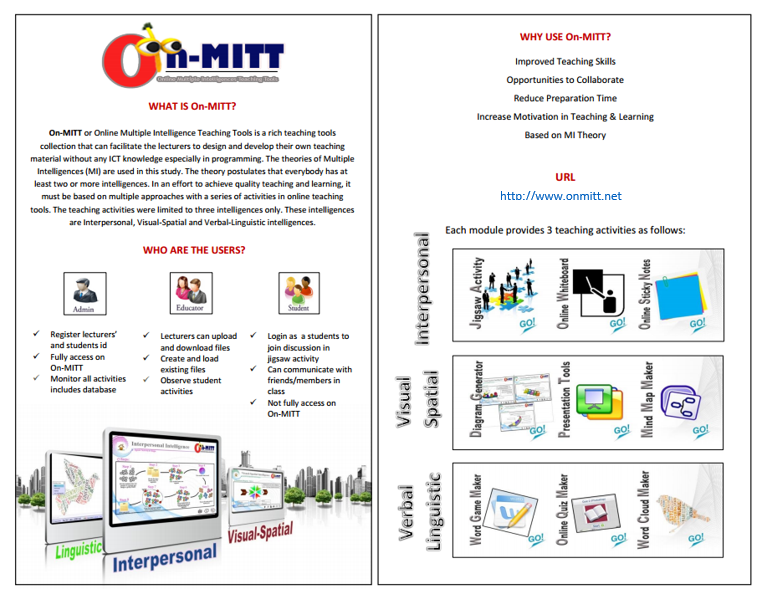 |
| On-MITT Teaching Activities |
Feel free to visit onmitt.net
Email to mahfuzah1112@gmail.com to request username and password
Multiple Intelligences Educational Courseware, 2008
Intan et. al (2008) believed that every human
being has at least one intelligent, and some of them can even possess to a maximum
of eight intelligences. MI Educational Courseware was developed based on the
theory of MI in education by Howard Gardner for Smart School in Malaysia. This
courseware provides a comprehensive and interactive notes, exercises, tutorials
and quizzes that equipped with animated graphics and games which can excite and
entertain students and improve the information transformation from short term
memory into long-term memory.

The strengths of this courseware
is before entering the system, students have to logon with their names and
personal password. This system will find student’s name in file user.txt
located in the project folder. If the student finds the user name in that specific
files and that particular password is match, the system will brings him to the
main menu. Teachers also have their own password that contains sensitive
information such as student’s marks. Teachers can edit and delete students
answer scripts from this site.
Another strengths of this courseware, teacher can update the content
without having to edit any Authorware files because the notes were built in
HTML format. They can edit and update these files using any HTML editor or web
editor or even Ms. Word. However, they have to save with the same file name
because Authorware package pieces will find file with the same name.
Example of game style learning,
learning through drawing, and click and drag exercises
The novelty of the courseware is
that the system can easily be customized, maintained and updated. As an
independent system, the courseware allows students to navigate through system
to a specific part of their interest. The courseware is focus on Chemistry
Subject (consists for 4 subtopic) at Sekolah Menengah Tengku Menteri Changkat
Jering Taiping, one of the smart schools in Malaysia.
A Framework for using Multiple Intelligences (EDUCE), 2004
A
different approach is taken by D.Kelly & B.Tangney(2004), developed an
Intelligent Tutoring System (EDUCE) that utilizes learning characteristics and
the Multiple Intelligences concept to provide an individualized learning
environment. EDUCE offers individualized learning by allowing the learner to
take the initiative and choose from a diversity of instructional methods. It
makes available a learning environment in which students can choose material
according to their need and preferences.
The authors presents
EDUCE’s framework for using Multiple Intelligences and describes how EDUCE
incorporates the Multiple Intelligences theory into its architecture and design
and demonstrates how students can choose between Multiple Intelligences
differentiated material.
EDUCE Architecture and the Role of MI
Multiple Intelligences Learning Activities (MILA) Model
Sakchai
et al (2008) proposed a MI Learning Activities (MILA) Model in e-learning
Environment & group the intelligences into 3 regions:
1. 1. Interactive domain
(Linguistic, Interpersonal and Kinesthetic)
2. Analytic domain (Logical- Mathematical,
Musical and Naturalist)
3.
Introspective domain
(Intrapersonal, Spatial and Existential)

Figure 1: Multiple Intelligences Learning
Activities (MILA) Model
Wednesday, July 3, 2013


Friday, July 2, 2010
Naturalistic Career
Potential Career Choices
Astronomer
Botanist
Wildlife illustrator
Meteorologist
Chef
Geologist
Landscape architect
Conservationist
Gardener
Ornithologist
Oceanographer
Entomologist
Beachcomber
Ethologist
Zoologist
Astronomer
Botanist
Wildlife illustrator
Meteorologist
Chef
Geologist
Landscape architect
Conservationist
Gardener
Ornithologist
Oceanographer
Entomologist
Beachcomber
Ethologist
Zoologist
Thursday, June 24, 2010
Naturalistic Activities
Children having naturalistic intelligence may exhibit some of the following characteristics. They may:
Have keen sensory skills - sight, sound, smell, taste and touch.
Readily use heightened sensory skills to notice and categorize things from the natural world.
Like to be outside, or like outside activities like gardening, nature walks or field trips geared toward observing nature or natural phenomena.
Notice patterns easily from their surroundings -- likes, differences, similarities, anomalies.
Are interested and care about animals or plants.
Notice things in the environment others often miss.
Create, keep or have collections, scrapbooks, logs, or journals about natural objects -- these may include written observations, drawings, pictures and photographs or specimens.
Are very interested, from an early age, in television shows, videos, books, or objects from or about nature, science or animals.
Show heightened awareness and concern of the environment and/or for endangered species.
Easily learn characteristics, names, categorizations and data about objects or species found in the natural world.
Have keen sensory skills - sight, sound, smell, taste and touch.
Readily use heightened sensory skills to notice and categorize things from the natural world.
Like to be outside, or like outside activities like gardening, nature walks or field trips geared toward observing nature or natural phenomena.
Notice patterns easily from their surroundings -- likes, differences, similarities, anomalies.
Are interested and care about animals or plants.
Notice things in the environment others often miss.
Create, keep or have collections, scrapbooks, logs, or journals about natural objects -- these may include written observations, drawings, pictures and photographs or specimens.
Are very interested, from an early age, in television shows, videos, books, or objects from or about nature, science or animals.
Show heightened awareness and concern of the environment and/or for endangered species.
Easily learn characteristics, names, categorizations and data about objects or species found in the natural world.
Activities that children with naturalistic intelligence will enjoy
To collect leaves, stones, bugs, flowers etc.
To identify the types of flowers and trees in your back yard or neighborhood.
To learn the different types of animals (e.g., types of dogs and cats, wildlife, squirrels, birds, etc.).
To develop an interest in collecting pictures of animals such as eagles, horses, or dogs or plants etc.
To do outdoor activities such as camping, fishing, gardening etc.
To watch National Geographic, the Discover Channel, or other programming that examines wildlife, fish, whales, and other animals.
Friday, June 18, 2010
Naturalistic Intelligence
Naturalistic is the most recent addition to Gardner’s theory (Gardner,2001) and has been met with more resistance than his original seven intelligences. According to Gardner, individuals who are high in this type of intelligence are more in tune with nature and are often interesting in nurturing, exploring the environment and learning about other species. These individuals are said to be highly aware of even subtle changes to their environments.
Naturalistic intelligence is the ability to recognize patterns in nature and to classify according to minute detail. For those students in tune with nature, the inclusion of the following activities may help them learn material by creating a naturalist inclusive atmosphere: nature walks, pet or plant in the classroom, and nature films (Amstrong, 1994). Armstrong also suggests using plants as props, this is where natural things or elements are used to explain course concepts and it also invokes learning from observation from class windows. To incorporate the naturalist intelligence, Kagan and Kagan(1998) suggest using categorization of class concepts. Activities such as blindfolded walks (for the purpose of relying on different senses), inferring, theorizing, keeping field logs, noting distinctions among similar items, understanding interdependence, hypothesizing, and experimenting all engage with the naturalist intelligence as well (Campbell, Campbell, Dickinson,1996).
Naturalistic intelligence is the ability to recognize patterns in nature and to classify according to minute detail. For those students in tune with nature, the inclusion of the following activities may help them learn material by creating a naturalist inclusive atmosphere: nature walks, pet or plant in the classroom, and nature films (Amstrong, 1994). Armstrong also suggests using plants as props, this is where natural things or elements are used to explain course concepts and it also invokes learning from observation from class windows. To incorporate the naturalist intelligence, Kagan and Kagan(1998) suggest using categorization of class concepts. Activities such as blindfolded walks (for the purpose of relying on different senses), inferring, theorizing, keeping field logs, noting distinctions among similar items, understanding interdependence, hypothesizing, and experimenting all engage with the naturalist intelligence as well (Campbell, Campbell, Dickinson,1996).
Wednesday, June 16, 2010
Intrapersonal Career
Characteristics of Intrapersonal Intelligence
•Good at analyzing their strengths and weaknesses
•Enjoys analyzing theories and ideas
•Excellent self-awareness
•Clearly understands the basis for their own motivations and feelings
Potential Career Choices
•Philosopher
•Writer
•Theorist
•Scientist
•Good at analyzing their strengths and weaknesses
•Enjoys analyzing theories and ideas
•Excellent self-awareness
•Clearly understands the basis for their own motivations and feelings
Potential Career Choices
•Philosopher
•Writer
•Theorist
•Scientist
Friday, June 11, 2010
Intrapersonal Activities
Strengths: Introspection and Self-Reflection
Individuals who are strong in intrapersonal intelligence are good at being aware of their own emotional states, feelings and motivations. They tend to enjoy self-reflection and analysis, including day-dreaming, exploring relationships with others and assessing their personal strengths.
Intrapersonal Intelligence Involves Being Aware of Self
•Keep a diary/journal about what they learn each day & what it means to them
•Share meaningful personal experience.
•Write about your perceptions.
•Focus on some particular weakness and strengthen it.
•keep track of his/her moods and feelings when working in a given area of study.
•imagine & create having a dialog with a famous figure, historical or otherwise.
Individuals who are strong in intrapersonal intelligence are good at being aware of their own emotional states, feelings and motivations. They tend to enjoy self-reflection and analysis, including day-dreaming, exploring relationships with others and assessing their personal strengths.
Intrapersonal Intelligence Involves Being Aware of Self
•Keep a diary/journal about what they learn each day & what it means to them
•Share meaningful personal experience.
•Write about your perceptions.
•Focus on some particular weakness and strengthen it.
•keep track of his/her moods and feelings when working in a given area of study.
•imagine & create having a dialog with a famous figure, historical or otherwise.
Tuesday, June 8, 2010
Intrapersonal Intelligences
The person with intrapersonal intelligence can be introverted, prefers to work alone and has clear knowledge of what he or she needs in most settings. This knowledge is based on a very keen understanding of self. Such people may be excellent at self-reflection and possess clear goals for the future. They also may be highly motivated people because of what appears to be an innate understanding of what they need.
Some people who agree with Gardner’s theories believe that those who possess intrapersonal intelligence in great degree need opportunities to work alone, but may require some extra care because of a high level of perfectionism associated with this form of intelligence. Children who seem very self-reflective but that lack interpersonal skills might be served by being encouraged to work in group settings from time to time to develop other intelligences. The inherent danger of intrapersonal intelligence is that the person becomes too reclusive because he or she is most satisfied by his own thoughts or work. Helping such people learn not to isolate themselves and to tolerate others who may have different goals can be valuable.
In college, students are given an opportunity to reflect and express themselves through the materials they are learning. Students need to examine their belief systems and values in relation to the materials being studied or discussed and may call for higher-order thinking and reasoning such as synthesizing. Meta-cognitive processing where students need to think about and analyze their own patterns of thinking would play a pivotal role in the acquisition of intrapersonal intelligence. Activities such as autobiographical reporting, or reflective exercises which explore how certain issues or events have changed one's life lend themselves effectively to developing interpersonal intelligence.
Instructors can include the intrapersonal intelligence through activities such as independent study, self-paced instruction, individualized projects and games, private spaces for study, one minute reflection periods, encouraging personal connections, options for assignments or projects, exposure to inspirational/motivational curricula, journal keeping, self-esteem activities, and goal setting (Armstrong, 1994). Campbell, Campbell, and Dickinson(1996) also add the following activities for the inclusion of intrapersonal intelligence: compliment circles, individual acknowledgement, peer support, challenging students to learn, metacognition and encouraging the identification and expression of feelings.
Some people who agree with Gardner’s theories believe that those who possess intrapersonal intelligence in great degree need opportunities to work alone, but may require some extra care because of a high level of perfectionism associated with this form of intelligence. Children who seem very self-reflective but that lack interpersonal skills might be served by being encouraged to work in group settings from time to time to develop other intelligences. The inherent danger of intrapersonal intelligence is that the person becomes too reclusive because he or she is most satisfied by his own thoughts or work. Helping such people learn not to isolate themselves and to tolerate others who may have different goals can be valuable.
In college, students are given an opportunity to reflect and express themselves through the materials they are learning. Students need to examine their belief systems and values in relation to the materials being studied or discussed and may call for higher-order thinking and reasoning such as synthesizing. Meta-cognitive processing where students need to think about and analyze their own patterns of thinking would play a pivotal role in the acquisition of intrapersonal intelligence. Activities such as autobiographical reporting, or reflective exercises which explore how certain issues or events have changed one's life lend themselves effectively to developing interpersonal intelligence.
Instructors can include the intrapersonal intelligence through activities such as independent study, self-paced instruction, individualized projects and games, private spaces for study, one minute reflection periods, encouraging personal connections, options for assignments or projects, exposure to inspirational/motivational curricula, journal keeping, self-esteem activities, and goal setting (Armstrong, 1994). Campbell, Campbell, and Dickinson(1996) also add the following activities for the inclusion of intrapersonal intelligence: compliment circles, individual acknowledgement, peer support, challenging students to learn, metacognition and encouraging the identification and expression of feelings.
Saturday, June 5, 2010
Interpersonal Career
People with Interpersonal intelligence are good with people and thrive in social interactions. They are good at reading, empathize and understanding others. They are good at working with others and have many friends. They learn best through interaction and dialogue.
Common Characteristics
Empathetic
Extraverted
Enjoy social events
Love groups and crowds
Enjoying teaching others
Have many friends
Enjoy team sports
Like to counsel others
Love meeting new people
Cooperative in groups
Sensitive to others' moods
Career Matches
Diplomat
Leader
Manager
Politician
Clergy
Social Worker
Receptionist
Sales Representative
Counselor
Child Care
Coach
Common Characteristics
Empathetic
Extraverted
Enjoy social events
Love groups and crowds
Enjoying teaching others
Have many friends
Enjoy team sports
Like to counsel others
Love meeting new people
Cooperative in groups
Sensitive to others' moods
Career Matches
Diplomat
Leader
Manager
Politician
Clergy
Social Worker
Receptionist
Sales Representative
Counselor
Child Care
Coach
Tuesday, June 1, 2010
Interpersonal Activities
Involves Being People-Smart
•Participate in group projects.
•Combined learning.
•Party in a group.
•Conduct a meeting to solve problems.
•Resolve conflict.
•Discuss and debate an issue.
•Brainstorm on any subject.
•Interpret others' feelings.
•Join a sports activity group.
•Form activity or social clubs.
•Participate in group book reading and share views.
•Participate in group projects.
•Combined learning.
•Party in a group.
•Conduct a meeting to solve problems.
•Resolve conflict.
•Discuss and debate an issue.
•Brainstorm on any subject.
•Interpret others' feelings.
•Join a sports activity group.
•Form activity or social clubs.
•Participate in group book reading and share views.
Sunday, May 30, 2010
Interpersonal Intelligence
Interpersonal intelligence is the ability to make distinctions among other individuals in regard to their moods, motivations and temperaments and to communicate with others. Interpersonal intelligence would emphasize the ability of students to work as part of a group, which requires verbal and non verbal communication skills, co-operation and empathy within a group. The focus would be on learning in groups or in pairs. Students should be encouraged to use the knowledge and skills to help the group or partner succeed. Brainstorming, coaching, demonstration of certain skills, carrying out surveys and writing a report on the findings, projects, discussion and debates would be some of the activities under interpersonal intelligence.
To help students learn with and from others, instructors can incorporate cooperative groups, interpersonal interaction, conflict mediation, peer teaching, group brainstorming, peer sharing, community involvement, and parties or social gatherings as context for learning (Armstrong, 1994). Approaches such as encouraging the development of social skills and service learning are also interpersonally grounded (Campbell, Campbell, Dickinson,1996), as well as interviewing for knowledge and finding individuals with like interests. (Kagan and Kagan ,1998). To encourage interpersonal interaction in my classes, students often work in small groups that I assign. Later in the semester, students have become comfortable enough to choose their own groups.
To help students learn with and from others, instructors can incorporate cooperative groups, interpersonal interaction, conflict mediation, peer teaching, group brainstorming, peer sharing, community involvement, and parties or social gatherings as context for learning (Armstrong, 1994). Approaches such as encouraging the development of social skills and service learning are also interpersonally grounded (Campbell, Campbell, Dickinson,1996), as well as interviewing for knowledge and finding individuals with like interests. (Kagan and Kagan ,1998). To encourage interpersonal interaction in my classes, students often work in small groups that I assign. Later in the semester, students have become comfortable enough to choose their own groups.
Friday, May 28, 2010
Visual/ Spatial Career
People with Visual intelligence are artistic. They are very aware of their surroundings and are good at remembering images. They have a great sense of direction. They like to draw, paint and read maps. They learn best through drawings and visual aids
Common Characteristics:
Good at solving visual puzzles
Enjoyed geometry in school
Good at drawing
Can visualize pictures in head
Notices colors and shapes
Enjoys photography
Good with directions
Can remember places vividly
Good at artistic composition
Likes books with pictures
Careers for Visual Thinkers
Here are some careers that use strength in visual-spatial thinking:
• scientist • advertising
• inventor • designer
• poet • chef
• musician • entrepreneur
• artist • self-employment
• sports-person • coach/teacher
• architect • mathematician
• computer systems• marketing
Common Characteristics:
Good at solving visual puzzles
Enjoyed geometry in school
Good at drawing
Can visualize pictures in head
Notices colors and shapes
Enjoys photography
Good with directions
Can remember places vividly
Good at artistic composition
Likes books with pictures
Careers for Visual Thinkers
Here are some careers that use strength in visual-spatial thinking:
• scientist • advertising
• inventor • designer
• poet • chef
• musician • entrepreneur
• artist • self-employment
• sports-person • coach/teacher
• architect • mathematician
• computer systems• marketing
Subscribe to:
Posts (Atom)

Categories of Intelligences Types